Build your own PBX: OpenRings opens a new era in business communication
Building a PBX used to be a big game. You needed a legacy switch, a pile of modules, a WebRTC proxy, a fax server, a queue add-on and months of glue. Today RingQ founder Chockalingam Manikandan revealed OpenRings to the public: an open-source PBX, SIP switch and contact-centre engine written in Go, shipped as one program you run and control from the command line. If you have ever wondered how to build your own PBX, it is now genuinely easy.
$ git clone https://github.com/ringq-devs/orswitch && cd orswitch
$ make build
$ bin/orswitch -conf conf -check
configuration OK: 1 domain(s), 4 users, 2 dialplan contexts, 0 gateways, 0 ring groups, 0 IVR menus
$ bin/orswitch -conf conf
Why build your own PBX now?
For twenty years, an open-source phone system meant assembling a legacy stack: FreeSWITCH or Asterisk underneath, FreePBX or a custom panel on top, and separate projects for browser calling, fax and call-centre work. Those projects did a great deal for the industry. They were also designed before browsers could make calls, before cloud servers were a few dollars a month, and before a single static binary could do the whole job.
“Starting a new phone platform on a legacy stack is not on the table anymore. Building a PBX is not a big game now. With OpenRings, anyone can download one program, write a few lines of configuration and run their own phone system, call centre and fax service in an afternoon. RingQ is proud to give that to everyone, in the open.”
Chockalingam Manikandan, Founder, RingQ
What is OpenRings?
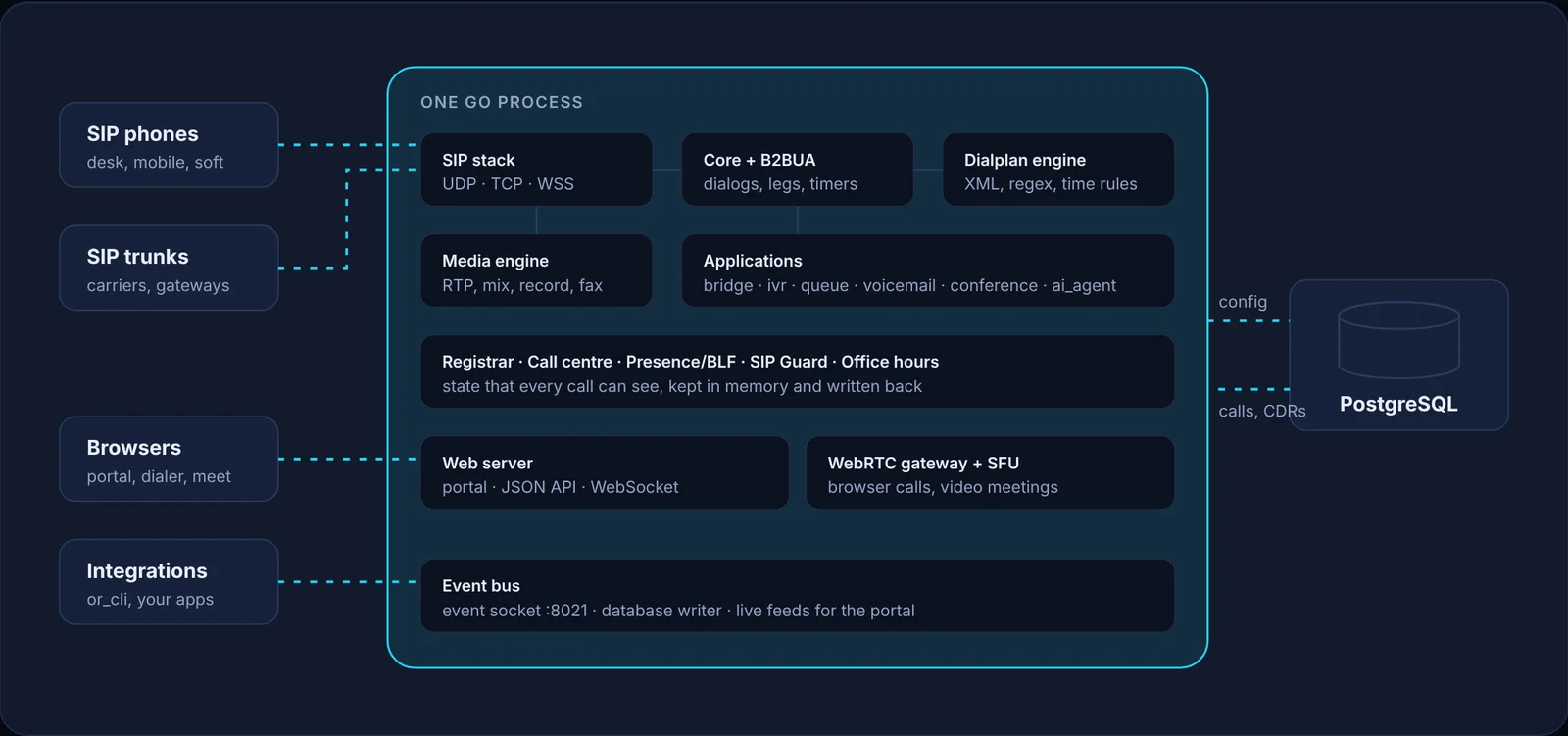
OpenRings (the switch is called orswitch, the console or_cli) is a complete software PBX and contact-centre engine in a single Go binary. It handles SIP phones and trunks, routes and records calls, and runs queues, IVR menus, voicemail, conferences and fax. The source is on GitHub under the AGPL v3, with a commercial license from RingQ Ltd for companies that need one.
- One static binary. Pure Go with every dependency vendored: no C compiler, no module hunt. Runs on Linux x86-64 or ARM64.
- WebRTC native. A built-in WebRTC gateway and SIP over WebSocket, so browsers can call with no extra proxy.
- eFax built in. A T.30 fax engine with T.38 over UDPTL, through the
rxfaxandtxfaxapplications. - Call centre ready. Queues with nine strategies (longest idle agent, round robin, ring all and more), tiers, wrap-up time and AUX break codes, driven from the phone or the event socket.
- Familiar for switch engineers. An XML dialplan and an event socket API, so existing know-how carries over.
orswitch -compatreports anything in your dialplan it does not support. - Modern extras. Call transcription, AI voice agents, office hours and SIP Guard, which blocks attackers after failed sign-ins.
Run it from the console
Everything you need day to day is one command away. This is a fresh switch, straight after start:
$ sudo or_cli -x status
UP 3s
ORswitch 0.10.1 is ready
0 session(s) active - max 1000
0 registration(s)
0 address(es) blocked for failed authentication
0 rtp port pair(s) in use (range 16384-32768)
SIP 192.0.2.2:5060 (tcp=true)
memory 3 MiB, 11 goroutines
$ sudo or_cli -x "show registrations"
$ sudo or_cli -x "show calls"
Three megabytes of memory for a ready switch. A call plan is plain XML you can read, review and keep in git:
<extension name="echo">
  <condition field="destination_number" expression="^9196$">
    <action application="answer"/>
    <action application="playback" data="tone_stream://$${beep}"/>
    <action application="echo"/>
  </condition>
</extension>
Legacy stack vs OpenRings
| You need | Typical legacy stack | OpenRings |
|---|---|---|
| Switch | FreeSWITCH or Asterisk plus modules, often with FreePBX on top | One program |
| Browser calling | Extra WebRTC configuration or proxy | Built-in WebRTC gateway |
| Fax | Add-on module or separate server | Built-in T.30 and T.38 |
| Call centre | Separate queue module | Queues, tiers and AUX codes included |
| Install | Packages, dependencies, modules | One static binary on Linux (x86-64 or ARM64) |
FreeSWITCH and Asterisk remain mature, battle-tested projects with large communities. OpenRings is younger (version 0.10), so test it with your own phones and carriers before you move production traffic. What it changes is the starting point: you begin with a whole platform, not a kit of parts.
How easy is it to build your own PBX?
- Install OpenRings on a Linux server with the quick start guide (about ten minutes).
- Set your passwords and public IP in
/etc/orswitch/orswitch.xml. - Run
orswitch -check, then start the service. - Register a SIP phone or softphone and dial
9196: you hear yourself back. - Add your carrier as a gateway and your numbers to the dialplan.
Who is OpenRings for?
- Developers and startups who want to build their own PBX or a voice product without licensing a black box.
- Service providers and integrators who host phone systems for many customers, with multi-domain support.
- Contact centres that want queues, agents and transcription in one engine.
- Teams leaving legacy stacks who want a modern switch they can read, change and own.
Open source, backed by RingQ
OpenRings is built by the team behind RingQ, the cloud contact-centre platform. The code is public under the AGPL v3, so you can run it, study it and improve it. Companies that want to ship it inside a closed product, or need a large deployment with support, can take a commercial license from RingQ Ltd.
Start today. Read the quick start, star the project on GitHub, or talk to sales about a commercial license.